


Cookware: Benefiting from the Elements of Nature
- Carrie Lavie

- Apr 25
- 5 min read

Ayurvedic Cookware: A Clinical Perspective on Materials, Function, and Health Implications
It is said that Ayurveda is an Ocean, so one is always a student, regardless of how deep and how long you have studied. Any avenue that you travel down will certainly provide a pool of knowledge that addresses the many aspects of our lives and the environment that we live in. With the knowledge of the Panchamahabhutas (The Five Great Elements) - Ether, Air, Fire, Water, Earth - we can gain a deep understanding into how this nature without interacts with the same elements of nature within. Cookware plays an important role in the cooking of not only food, but also decocotions, and the preparation of herbal medicines - internal and external (medicated ghee, herbal oils, and traditional formulations for healing, and so on).
In fact, if you really sit and ponder this, everything is in fact Ahara (input), the air, the grains, legumes and vegetables that we harvest from the ground; the water that is routed from the lakes, springs, or rain; the metals that are mined and formed into multiple uses. No piece of nature is completely inert, or without influence. The world is in a constant dynamic flow of change, catabolism and anabolism, building up and taking down, adding and subtracting. External inputs can be through subtle channels (such as sight, breath, or osmosis), or through physical application or input. As per Ayurveda, everything is considered to be a potential medicine.
Cookware has the potential to influence the energy and nutrient availability of your food, the flow of prana (life force), as well as the balance of the doshas. In terms of cooking, materials like iron, stainless steel, brass, copper, clay, and earth all interact with food in different ways. Iron is well know for its ability to impart trace amounts of iron into food during cooking, making it an ideal material for vegetarians or anemic individuals to cook with. Among other uses, copper is becoming so well known for its cleansing and antibacterial benefits that some hospitals have even started including it in their treatment rooms for enhanced hygeine.
Below is a small dive into the world of Ayurvedically informed cooking vessel applications.
Material Categories and Clinical Considerations
1. Clay (Earthenware)
Clay cookware is characterized by its porous structure and relatively low thermal conductivity, resulting in slow, uniform heating. As is evident by its name, it is heavy in the Earth quality. Heat and moisture circulate gently, enhancing both flavor and prana.
Applications: Low-temperature cooking, aqueous preparations such as legumes and stews. In the summer, water can be stored in clay vessels as they are naturally cooling. Can be aligned with Pitta pacification, although it will depend on the use and imbalance.

2. Cast Iron
Cast iron demonstrates high heat retention and durability, with measurable dietary iron under certain conditions, especially when acidic ingredients are used (such as tomato, tamarind, or apples).
Applications: High-temperature cooking, searing, and frying. Cast iron dutch ovens are also ideal for long cooking with maximum retention of heat and liquid thanks to their heavy tight fitting lids.

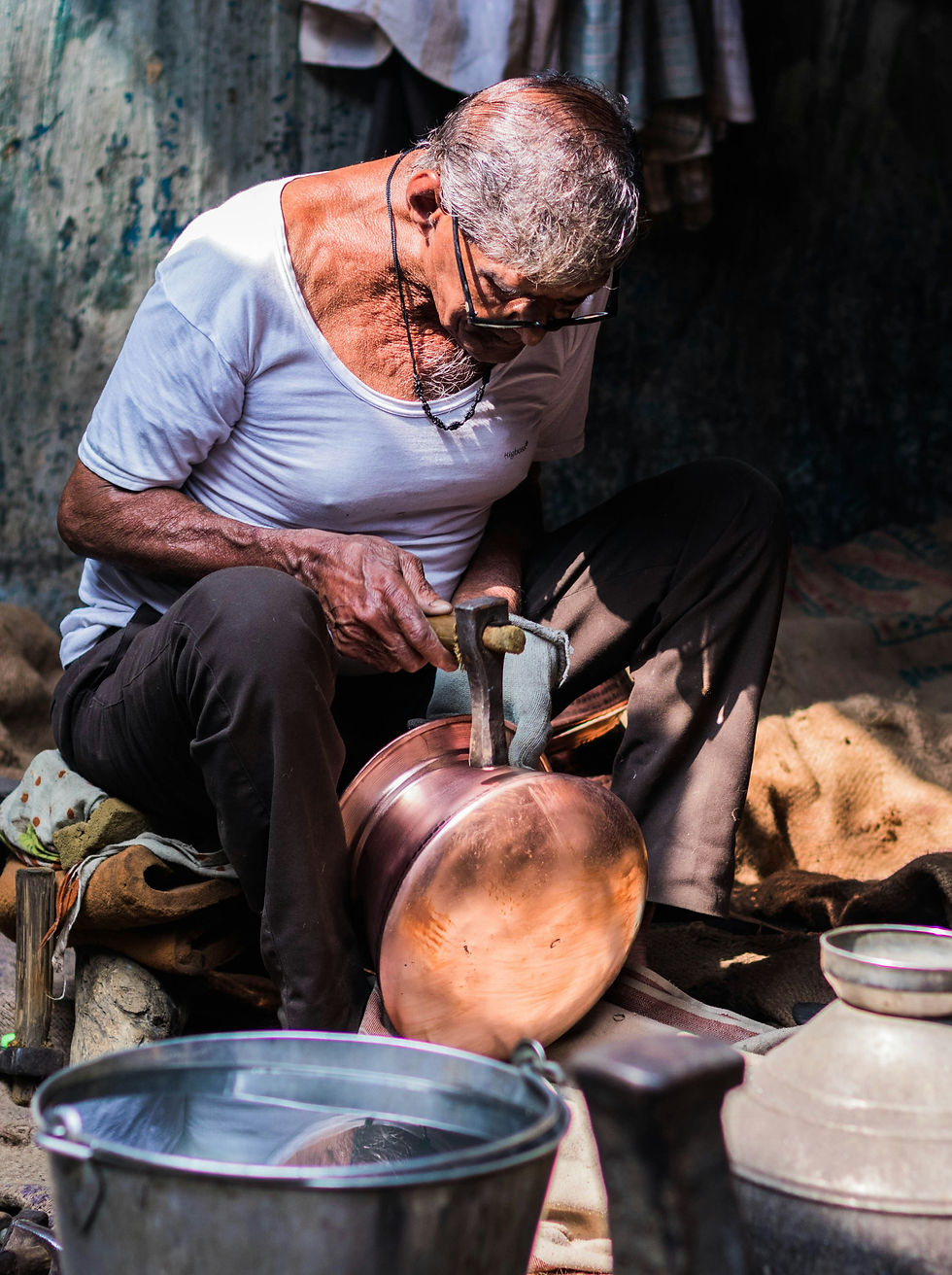
3. Copper
Copper is a highly conductive metal with known antimicrobial properties.
Applications: Primarily for water storage; some use in cooking when properly lined. Store water in (clean) copper cups or jugs for early morning water consumption that assists in clearing the channels. Can be aligned with Kapha pacification, although it will depend on the use and imbalance.
4. Brass, Kansa
Brass (an alloy of copper and zinc) and kansa (copper-tin alloy) are traditionally used in Ayurvedic contexts.
Applications: Cooking and serving non-acidic foods. Mainly used in serving rather than extended cooking. (Other Ayurvedic uses include ritual, kansa wand or bowl for massage, kansa comb, etc.)
"Before the periodic table, there was Vedic alchemy.
Somewhere between 3,000 and 5,000 years ago, metallurgists working within the Ayurvedic tradition made a discovery: copper and tin, combined at a precise 78:22 ratio, did not just form an alloy. They formed something new. A third substance with its own molecular vibration, its own temperature, its own relationship with the human body. They called it Kansa, the healing metal.
True Kansa cannot be manufactured. It must be tempered: heated to a red glow, hammered, quenched, heated again, in a cycle that can only be done by hand.
This process lives within a small number of hereditary smith clans in India, passed down through generations who never wrote the knowledge down because they never needed to. Their hands carry it.
The result is a metal that has outlasted every trend in wellness because it was never a trend. While the world moved to stainless steel and plastic, Kansa stayed, patient and hand hammered, waiting to re enter the rituals it was made for." - Vaarsa London

5. Stainless Steel
Although not a classical Ayurvedic material, stainless steel is widely adopted in modern contexts due to its stability.
Applications: General-purpose cooking across a wide range of foods. Non-reactive. Generally neutral, for all doshas.

Potential Health Implications
From a clinical perspective, Ayurvedic cookware may influence health outcomes through several mechanisms:
Micronutrient Modulation: Materials such as cast iron can influence dietary iron intake.
Chemical Exposure: Natural cookware is one way to reduce the chemical load of modern life (replacing plastic and non-stick cookware which costs the environment to produce, and can leech chemicals into cooking - especially when heated).
Food Matrix Integrity: Slower cooking methods may preserve nutrient structure and improve digestibility.
Increased Hydration: Slow cooking in closed containers helps to maintain the water content, counterbalancing dryness and aiding in digestion. Liquid can also be added to obtain a moist and nutrient rich dish.
Microbial Control: Certain metals (e.g., copper) exhibit antimicrobial activity.
Beauty, The Forgotten Ingredient: Beauty is a part of cooking. Part of the inspiration for cooking is the experience of beauty while preparing - it is a form of mindfulness, and it infuses the meal with prana and sattvic loving energy. There is a very different feeling when receiving and ingesting "soul" food as opposed to fast food. Many of the above have ritualistic significance and sacred association. It's sight, feel and impression adds a different dimension to the kitchen and cooking process.
Note: All benefits are contingent on proper material sourcing, maintenance, and usage. Doshic influence can vary as well, depending on use, and on the dish that is being made. As always in Ayurveda, "it depends" is the general rule, so be sure to seek out appropriate guidance if you are hoping to obtain therapeutic benefits.
Practical Recommendations
Traditional Indian made cookware is beautiful, and often handcrafted. They are often shaped according to use for the most optimal cooking. Ptal has a beautiful line that is easily delivered, and Etsy has many choices. Be sure to investigate into its use (ornamental or functional) and material (authentic or a copy made from materials such as aluminum).
There are many options available in North America as well: Le Crueset is cast iron with an enamel coating; Staab is cast iron; Lodge is cast iron; Mauviel is a traditional French copper brand; and there are multiple stainless steel options available. Check flea markets for antique copper or brass cookware (be sure to clean well with appropriate cleaners).

Conclusion
Cookware composed of natural materials represents an intersection between elemental science, food science, nutrition, and subtle inputs. Choosing cookware made from natural materials also helps to reduce the body's overall chemical exposure, and is a better choice for the environment.


Comments